
 Jee Ltd

Overview
Jee help operators manage ageing pipeline infrastructure and integrity risk by delivering clear and reliable remnant life assessments. The process starts with a review of historical ILI data, followed by the matching of corrosion defects between inspection runs to establish credible corrosion growth rates. These rates are projected forward to identify when each corrosion defect is expected to exceed recognised code limits, typically Jee use DNV-RP-F101, Kastner, and ASME B31G.
This structured approach provides operators with clarity on future integrity constraints, the actions required to remain within safe operating windows and the options available for repair, derating or replacement. It also reflects Jee’s ability to interpret complex inspection data and turn it into practical, defensible engineering guidance.
To support clients with very large or complex ILI datasets, Jee works in partnership with Irth Solutions. Irth’s Asset Integrity for Pipelines (AIP) software leverages artificial intelligence and machine learning to ingest multiple ILI tally sheets and perform run comparison analysis to generate defect specific corrosion growth rates. This provides key information regarding how corrosion is progressing within the pipeline and is a key input to the remnant life assessment process. Irth’s AIP software significantly reduces run comparison processing time and increases consistency in defect matching for larger data volumes.
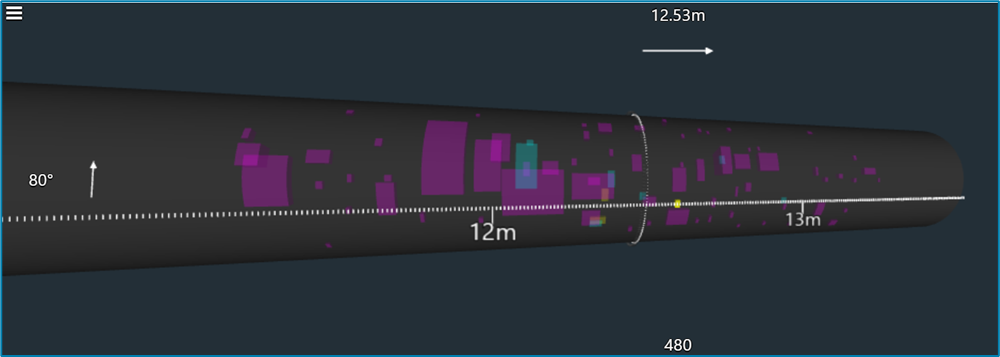 Irth AIP joint view showing corrosion defects from multiple ILIs
Jee uses Irth’s outputs as an optimisation step within the wider engineering workflow. Several of the most onerous defects are identified and the corrosion rates are validated by Jee through manual checks. This is done to ensure technical accuracy before being used in remnant life modelling.
The combination of automated run comparison with Jee’s engineering review provides a balance of speed, traceability and assurance for clients managing extensive inspection histories. This is where Jee’s value is clearest: expert scrutiny, interpretation and decision making grounded in recognised integrity codes.
Project 1
Scope
A client requested a run comparison and fitness for service assessment for a 100 km oil pipeline. Four historical ILI reports were provided, including more than 7000 metal loss defects in the latest inspection. Jee was required to determine representative corrosion growth rates, calculate the remnant life of every defect then advise on repair requirements to maintain safe operation.
Solution
Jee first completed a detailed defect matching exercise. Given the high defect count, matching was carried out using Irth’s run comparison tool to standardise the datasets, align them to the pipeline reference system and automatically match features. Irth’s outputs were then verified by Jee through manual cross checks to confirm the calculated growth rates. Differences were small and typically linked to matching tolerances, giving confidence in the derived corrosion rates.
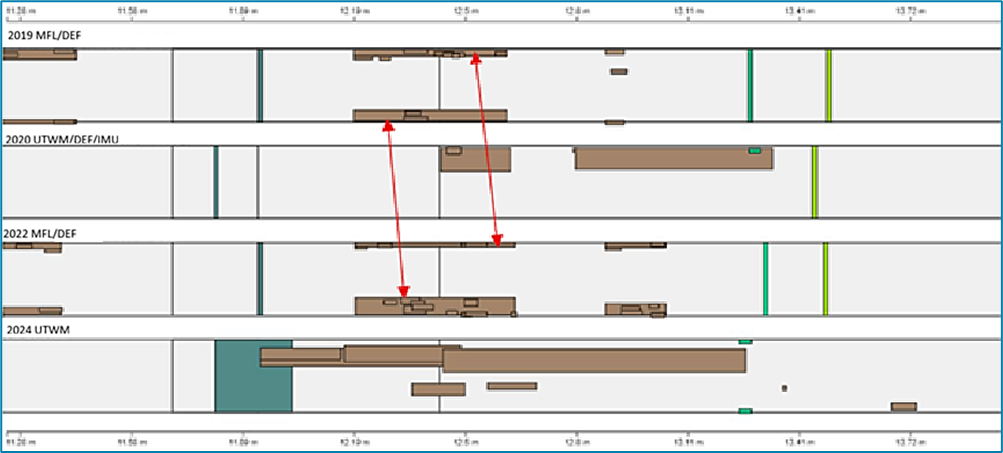 Pipe joint alignment and defect matching within Irth software
Using these validated rates, Jee projected defect growth from the most recent ILI dataset and assessed future acceptability in line with DNV-RP-F101.
Conclusion
Jee provided the client with clear recommendations on locations requiring remediation. The results enabled the operator to plan cost effective interventions, maintain safe operation for the required period and manage risk in a pipeline with significant corrosion activity. Jee added value by applying specialist engineering judgement alongside automated tools to convert large volumes of inspection data into clear, actionable guidance for managing corrosion risk and planning interventions. This included plotting repair locations on GIS which allowed accessibility to the pipeline to be confirmed.
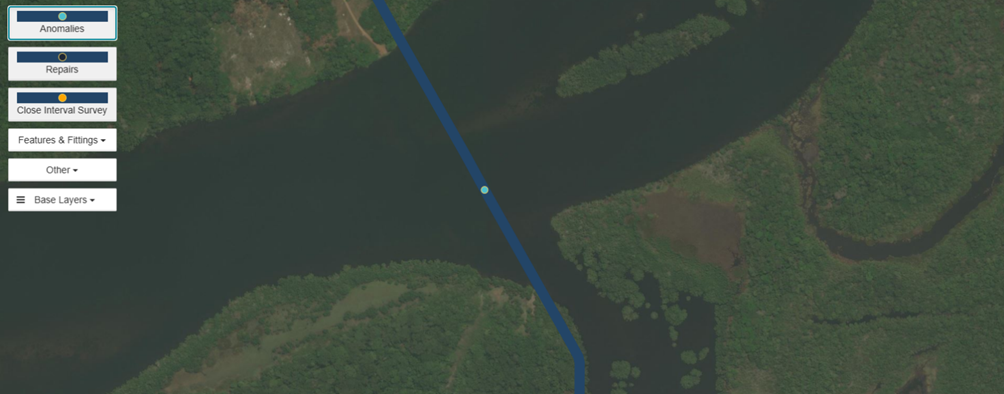
Figure: Defect identified as not being readily accessible for repair due to location within river crossing
Project 2
Scope
The client required a full fitness for service assessment for two production pipelines with ILI data from 2016 and 2025. Almost 10,000 defects were reported in the latest run and the pipelines included sections replaced with flexible flowlines between inspections, creating alignment challenges.
Solution
Jee carried out the full defect matching exercise manually to ensure correct treatment of replaced sections and discontinuities in the pipeline system. The results were then independently checked using Irth’s run comparison tool to verify the feature alignments and growth calculations. Minor differences were attributed to matching tolerances or earlier run data, confirming the reliability of Jee’s manual assessment.
Using the validated corrosion growth rates, Jee completed a full remnant life assessment under best estimate and upper bound corrosion scenarios in line with DNV RP F101. The work identified features with shorter remaining life and sections requiring targeted assessment or operational risk mitigation. The study also helped the client explore options such as MAOP derating and inspection timing.
Conclusion
Despite the complexity introduced by pipeline replacements and difficult inspection histories, Jee delivered a robust set of corrosion growth and remnant life calculations. The results allowed the operator to identify features approaching code limits and focus API 579 Level 3 assessments on the most critical locations where greater assessment detail was required. This enabled targeted planning for future inspections and continued safe operation up to the planned cessation of production. Irth’s tool provided an additional verification layer while Jee’s engineering judgement ensured reliable assessment across sections where automated alignment was not possible.
Together these projects demonstrate how Jee combines deep technical expertise, careful validation and structured engineering assessment to manage complex inspection histories and large defect populations.
By using digital tools, like Irth’s run comparison and CGA technology, where they add efficiency and applying expert review where engineering judgement and interpretation are critical, Jee delivers clear and defensible integrity guidance that helps operators plan ahead and manage ageing assets in a challenging energy landscape.
For more information, visit www.Jee.co.uk/Integrity-Management
To contact Jee’s Technical Authority, Graham Wilson, email Graham.Wilson@jee.co.uk or call +44 (0)1732 371 371.