Scope
Jee was asked to evaluate the structural integrity of a subsea Pipe-in-Pipe (PiP) gas export system that includes multiple mid-line expansion spool loops. Free spans have previously been observed across the spool regions and the main pipeline. Free spans introduce the risk of Vortex Induced Vibration (VIV), which can cause fatigue failure pipelines. Assessment of PiP systems is more complex due to the dynamic interaction between the inner and outer pipes.
Our solution
The Our solution combined FE modelling, span VIV analysis and operational fatigue assessment to determine the predicted fatigue life for a range of span lengths and heights.
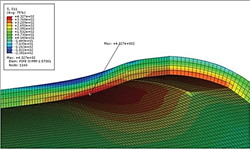
An Abaqus FEA model was developed to calculate the natural frequency, and internal forces within each span. The inner and outer pipes were modelled as separate element sets to capture the true composite bending and axial load-transfer behaviour, accounting for the PiP spacers and bulkheads.
Based on the FEA results gathered, DNV-RP-F105 fatigue calculations were carried out for both in-line and cross-flow VIV to determine the governing fatigue lives for the range of span lengths and heights. A maximum allowable span length was calculated, and this will be used in future inspections as a screening limit to identify spans at risk of failure.
Any existing spans that were longer than this screening limit, were assessed in more detail, accounting for seabed geometry, and pipeline temperature at each span location.
Operational fatigue was calculated with stress cycles derived from the pressure and temperature history over the previous 22 years of operation. The analysis showed the predicted fatigue damage from operational conditions was very small, and the overall fatigue performance was governed by VIV.
VIV damage of the existing spans was calculated over the previous 22 years of operation and combined with predicted future fatigue. The position of each span was mapped using historical pipeline surveys, meaning the analysis could account for movement of the peak stress location, as the position of the span shoulders moved due to continuous seabed scour and sandwave migration.
The final analysis was able to show that all existing spans were predicted to meet the end-of-life date for the pipeline. This avoided costly span remediation work that would have been required if a more conventional and conservative span assessment technique had been applied.
For more information, visit www.Jee.co.uk/Integrity-Management
To contact our Head of Integrity Management, Graham Wilson, email Graham.Wilson@jee.co.uk, or call +44 (0)1732 371 371.



 Jee Ltd