Subsea pipelines are central to offshore energy projects because they transport hydrocarbons from offshore facilities to onshore processing sites. Building these systems requires specialist installation methods, careful planning and a clear understanding of the technical and environmental constraints that govern offshore construction.
The following guide summarises the main installation methods, construction activities and supporting processes used in subsea pipeline projects.
S lay method
The S lay method is widely used for shallow to mid depth projects. It creates a continuous workflow on the lay vessel where welding, testing and coating are completed before the pipeline is lowered to the seabed.
Key steps:
-
Pipe preparation including welding, bevelling and coating.
-
Lay vessel setup using a stinger to support the pipe as it curves toward the seabed.
-
Pipe assembly on the firing line where sections are welded.
-
NDT using RT, UT or MPI.
-
Field joint coating to protect the weld area.
-
Controlled installation where tension is managed to avoid overstressing the pipe.
Strengths
-
High productivity because several tasks occur in sequence.
-
Cost effective for large diameter and long lines.
-
Suitable for many pipe sizes and water depths.
Limitations
S lay remains a reliable solution for many offshore projects where vessel space and water depth align with its operational limits.
J lay method
The J lay method is designed for deep and ultra deep water. The pipe is assembled vertically inside a tall tower which reduces bending stress during installation.
Key steps:
-
Standard pipe preparation.
-
Set up of a vertical J lay tower with tensioners.
-
Vertical pipe welding in a stable working environment.
-
NDT inspection.
-
Field joint coating.
-
Lowering the pipeline in a controlled J shaped profile.
Strengths
-
Precise tension control in deep water.
-
High quality welding due to stable vertical alignment.
-
Suitable for heavy wall pipe and complex designs.
Limitations
J lay is the preferred technique for deep water projects where mechanical loads are significant and pipe control is essential.
Reel lay method
Reel lay provides fast and efficient installation for small to medium diameter pipelines along with umbilicals and flexible products.
Process overview
-
Pipe joints are welded onshore or onboard then spooled onto a large reel.
-
During installation, the line is unspooled, straightened and guided onto the seabed.
-
The vessel controls tension and alignment during movement.
Things to consider
-
Reel capacity limits the maximum installed length.
-
Spooling and straightening generate residual stress and fatigue.
-
Onboard welding stations may be required depending on project scope.
Reel lay offers rapid installation when pipe diameter, route length and material properties are compatible with reel loading.
Bundle and towed installation
Bundle installation places several pipelines, umbilicals and control lines inside a single prefabricated structure that is towed from shore to the field.
Key steps:
-
Bundle design and configuration.
-
Onshore fabrication in controlled conditions.
-
Addition of towheads containing valves and connection points.
-
Surface or submerged towing to site.
-
Placement on the seabed and connection to infrastructure.
Strengths
-
Multiple systems installed in one operation.
-
High quality onshore fabrication.
-
Can incorporate insulation and heating systems for flow assurance.
Limitations
Installation of flexibles
Flexible pipes are used where seabed terrain, dynamic loading or thermal movement make rigid pipelines unsuitable.
Key elements:
-
Manufactured from layered materials for strength and flexibility.
-
Installed by reel lay or S lay depending on vessel availability.
-
Umbilicals and bonded hoses can also be installed using similar methods.
Strengths
Limitations
-
Higher manufacturing cost.
-
Vulnerable to external damage.
-
Shorter service life depending on conditions.
Landfalls
Landfall construction links the offshore line to onshore facilities.
Techniques:
-
Pull ashore into a cofferdam for a controlled transition.
-
Pull from an onshore site for smaller lines.
-
Directional drilling under sensitive areas to minimise disturbance.
Tie ins
Tie ins connect new or separate pipeline sections.
Options:
-
Flanged connection by divers in shallow water.
-
Hyperbaric welding in a pressurised chamber for deeper connections.
-
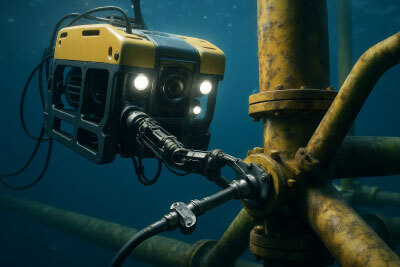
Diverless tie ins using ROVs for deep water.
Pre-commissioning
Pre-commissioning activities confirm that the pipeline is ready for service.
Main steps:
-
Gauging and flooding for cleanliness checks.
-
Hydrotesting to verify pressure capacity.
-
Dewatering and drying using air or vacuum systems.
-
Testing valves and control systems.
QSHE considerations
QSHE plays a central role throughout subsea pipeline projects.
Areas of focus:
-
Legal compliance with environmental and safety regulations.
-
Quality assurance through inspection and audits.
-
HSE management to reduce hazards.
-
Risk assessment to identify and mitigate potential issues.
-
Worker health and safety.
-
Environmental protection during all activities.
Survey requirements
Survey data guides route selection, design and installation.
Survey types:
-
Bathymetric surveys for seabed mapping.
-
Geophysical surveys for subsurface hazards.
-
Geotechnical surveys for soil properties.
-
Environmental surveys for ecological assessment.
Survey stages:
-
Pre installation route checks.
-
As laid monitoring during pipelay.
-
Post lay surveys to confirm final position and identify remedial needs.
Seabed modification
Seabed preparation ensures that the pipeline has a stable and safe foundation.
Common techniques:
-
Sweeping to clear debris.
-
Rock removal where necessary.
-
Protective coverings against external damage.
-
Rock dumping for stability or support.
-
Concrete mattresses and other protective structures.
-
Crossing supports for existing lines.
Post lay trenching and burial
Burial provides stability and protection.
Methods:
-
Ploughing for a wide range of soils.
-
Jetting for softer soils.
-
Cutting for hard or rocky seabeds.
-
Special approaches for cable corridors.
-
Backfilling using displaced soil or imported material.
Diving and ROV operations
Diving and ROVs support installation, inspection and repair.
Diving methods:
ROV capabilities:
-
Inspection class ROVs for surveys and routine checks.
-
Work class ROVs for heavy tasks such as tie ins and repairs.
-
Support systems including LARS, TMS and control cabins.
Summary
Subsea pipeline construction relies on a range of installation methods and supporting operations. S lay, J lay, reel lay, bundle installation and flexible pipe installation each serve different project needs. Landfalls, tie ins and pre commissioning link the offshore system to onshore facilities. Survey, seabed preparation, trenching and diving and ROV operations ensure safe installation and long term performance. With the right combination of methods and effective QSHE management, pipelines can be installed safely across varied offshore environments.
For more information, visit www.jee.co.uk/integrity-management
To contact our Head of Integrity Management, Graham Wilson, email graham.wilson@jee.co.uk, or call +44 (0)1732 371 371.


 Jee Ltd