Scope
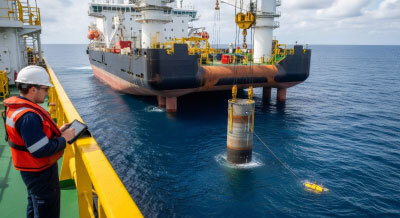
A transient simulation study was carried out to assess depressuriation response following a riser leak in a subsea oil export pipeline system. Previous assessments relied on simplified analytical methods that could not capture complex dynamics such as valve response time, frictional pressure losses, or circumferential pipe strain. A dedicated transient model was therefore developed to determine system response under a wide range of operating and failure conditions. The results supported our clients integrity assessment, emergency response planning and identification of credible release scenarios.
The objectives of the study were to:
- Model transient pressure, flowrate and release behaviour for a range of leak sizes.
- Determine leak scenarios under which an automatic shutdown valve (SDV) would close.
- Assess whether leak rates could sustain jet-type releases.
- Quantify the SDV leak orifice that produces a 4.2 kg/s release (taken as the threshold for jet formation).
- Verify the influence that low magnitude fluid compressibility has for a liquid pipeline system
- Evaluate the influence of system boundary conditions, operating modes and partial valve failures.
Solution
A detailed transient model was constructed, incorporating:
- Pipeline length, diameter and elevation profile
- Automated control systems to replicate pressure trip settings and valve closure
- Appropriate pressure and flowrate boundary conditions
- Leak orifice definition to represent a leak in the riser wall
- Physical pipe properties to capture the effects of hoop strain and
- Fluid properties representative of the export stream, tuned to match laboratory results
The following scenario families were simulated:
- Leak orifices of 15, 50 and 150 mm
- System operating states ranging from normal production to fully shut-in pipeline
- SDV leak orifices of 9.14, 15.9, 25 and ~71 mm (to simulate partial seal of SDV)
- Re-pressurisation sequences for SDV leak-size diagnostics
Each scenario captured pressure decay, release rate, total release volume, transient behaviour and SDV response.
Results
The transient simulations showed clear differences in system behaviour across leak sizes, SDV leak capacities and operating modes. During normal production, small riser leaks generated moderate release rates that were insufficient to trigger automatic isolation, demonstrating a low system sensitivity to minor failures. Only the largest leak case caused an immediate and substantial pressure drop capable of activating the shutdown logic.
The SDV leakage assessment confirmed that an SDV orifice of approximately 9.14 mm produces a stabilised release of around 4.2 kg/s, which represents the minimum flow required to sustain a jet-type release. Larger SDV leak areas led to higher and more persistent flowrates, with system behaviour increasingly controlled by the SDV rather than the riser geometry.
For small riser leaks, the riser remained the dominant flow-limiting feature, while for larger leaks the SDV leakage capacity governed the release. Re-pressurisation studies further demonstrated that pressure recovery time is highly sensitive to SDV leak size, providing a practical means of inferring SDV leakage severity during an event. Collectively, these findings highlighted the importance of both riser leak size and SDV leak capacity in determining the likelihood and persistence of a jet release and provide a clear basis for interpreting system behaviour during abnormal conditions. Our client was able to use these findings to fully risk assess the pipeline operation with regard to jet fire, leak detection and risk to personnel.
For more information or to download our Integrity Management capability statement, visit www.jee.co.uk/design.
To contact our Head of Design, John French, email John.French@jee.co.uk , or call +44 (0)1732 371 371.


 Jee Ltd
.png)