Scope
An offshore oil export pipeline was subject to in-line inspection (ILI) in late 2019. Following this inspection, a fitness-for-service assessment was performed in 2021 which determined that remnant life of the system was inadequate and was governed by internal corrosion features located within the topsides riser section and, in particular, three identified critical spools.
A regular programme of inspection of these critical spools was introduced using phased array ultrasonic testing (PAUT). With several years of detailed inspection data, Jee undertook a reassessment of fitness-for-purpose and remnant life.
The solution
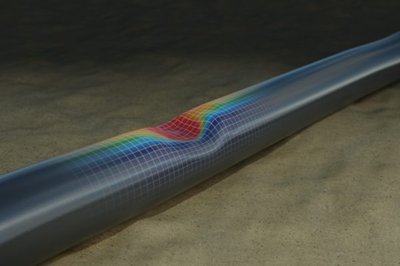
Jee carried out a detailed fitness-for-service and remnant life assessment using finite element analysis (FEA) in accordance with API 579 level 3 criteria.
The assessment used measured wall thickness mapping from the PAUT to develop detailed FEA models of the three internally corroded pipeline critical spools based on the latest inspections. The measured corrosion was characterised as densely clustered pitting located around the 6 o’clock position of the pipeline. To optimise analysis run times and costs, the FEA model included a high-resolution mapping of measured wall thickness in the 5-7 o’clock region where the corrosion pitting was concentrated but modelled the rest of the pipeline section in low-resolution based on nominal wall thickness.
Inspection data from 2022, 2023 and 2024 were overlayed and reviewed to establish the corrosion rates within the critical topsides locations and a conservative corrosion rate was determined for the purpose of remnant life assessment. To determine the remnant life, the mapped remaining wall thicknesses were reduced incrementally and reassessed, based on the measured corrosion rate, until failure of the pipe was predicted. The assessment considered local and global failure modes under pressure loading.
The benefits
The assessment gave the operator a clearer understanding of structural integrity, corrosion tolerance and remnant life for each spool. Most importantly, the analysis demonstrated that the remnant lives of the critical topsides spools were now assessed to be beyond the planned operating life of the system. The pipeline operator was able to use this analysis to demonstrate fitness-for-purpose for continued operation.
This work also provided a technical basis for ongoing monitoring and inspection planning, enabling a reassessment of inspection intervals in line with the operators risk-based inspection philosophy.
By applying detailed finite element analysis to measured corrosion data, Jee helped avoid an overly conservative outcome while maintaining confidence in pipeline integrity under maximum operating conditions. The operator gained practical, evidence-based insight to support safe operation and future integrity management decisions.
For more information, visit www.jee.co.uk/integrity-management
To contact Jee’s Technical Authority, Graham Wilson, email Graham.Wilson@jee.co.uk.


 Jee Ltd