
 Jee Ltd
Overview
Following a routine subsea survey of a mature offshore gas export system, Jee’s client – an operator in the Dutch North Sea - identified two free spans near to the riser base of a gas export pipeline. The spans were located close to the riser touchdown area and required assessment to establish their structural integrity under both current operating conditions and future loading scenarios. The client required an expedited engineering assessment to support integrity management decisions and determine whether remediation would be required.
Free span assessment
Jee was commissioned to undertake a detailed free span assessment of the pipeline system and associated riser interaction using advanced finite element modelling techniques.
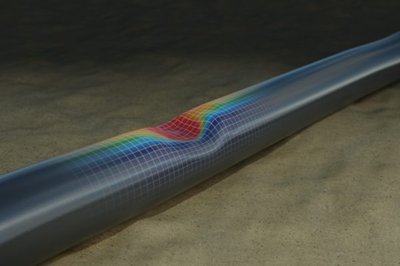
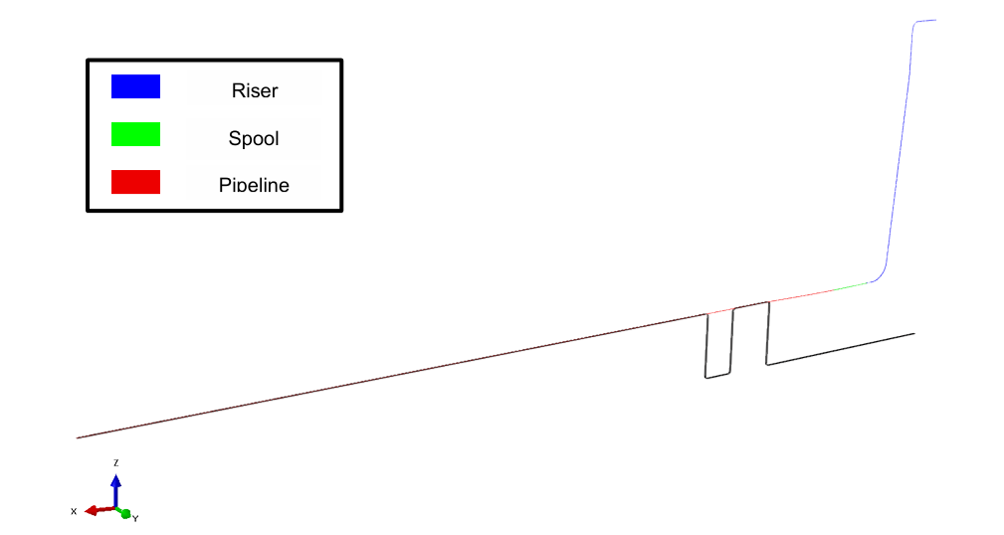
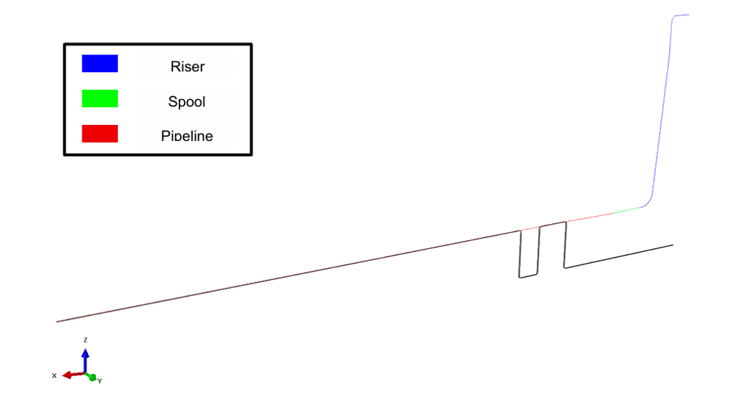
Jee's assessment, undertaken in accordance with DNV-RP-F105, identified that the as-observed free span configuration at the pipeline-riser transition was not suitable for long-term service. A detailed finite element model of the riser touchdown region and interacting spans was developed to evaluate structural response under operational and environmental loading (as illustrated in Figure 1). The assessment demonstrated that, under extreme environmental conditions, stresses within the riser and pipeline exceeded acceptable limits, while the unsupported spans were also susceptible to vortex-induced vibration (VIV), creating the potential for accelerated fatigue damage if left unmitigated.
Figure 1: Riser, spool and pipeline model in ABAQUS FEA
Quickfire Span Remediation
Once the unacceptability of the free spans was established, Jee developed and assessed several remediation options before a rock-support solution was selected. The selected remediation consisted of a rock berm placed beneath the pipeline using bags deployed from an IRM vessel, providing additional support and reducing the effective span lengths.
Upon completion, assessment of the remediated configuration demonstrated acceptable stress and local buckling utilisations, provided that the rock support remains in place and that neighbouring grout bags and the umbilical continue to suppress VIV. Jee concluded that the remediated span configuration is
acceptable for continued operation, while recommending ongoing survey monitoring to verify the integrity of the rock support and VIV mitigation features.
Benefit to the client
Thanks to the speed and efficiency of Jee’s calculations, the client was able to complete the remediation utilising an IRM vessel that was already mobilised in the area on a separate remediation project. This ensured that not only was the client able to remediate the spans, it was also able to avoid considerable costs – likely several hundred thousand pounds - in mobilising a vessel from port, on top of likely delays associated with locating an available vessel.
For more information, visit www.jee.co.uk/integrity-management
To contact Jee’s Technical Authority, Graham Wilson, email Graham.Wilson@jee.co.uk.